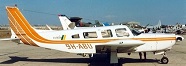





Photographs of the debris supposedly found by Tunisian fisherman in the Gulf Of Gebas.
The following is an explanation of the photographs taken by Cormac Boomer on 25th September 1997.
Note the volume of debris recovered is very small and specific given the overall size of the plane.
The remains of the instrument panel
The steering column with the right arm missing.
The rudder pedals and the
control handles for the engine ailerons and flaps One of the seatbelts recovered
Close up of the bottom of the steering column
Accumulation of rust suggests this was out of the water and exposed to atmosphere for a long period of time. Also shown with the name Piper and the control handles
Control cable and linkage from around the steering column
One end of the stainless steel cable is frayed and bent the investigator stated this condition
is the result of being stretched beyond breaking point.
The other end suggests a twisted wrung off break
No explanation why the two ends should be different
The landing gear leaver handle
This is in the first notch position. This would indicate the landing gear was partially lowered.
Also depicted are two seat belts
Closeup of the rudder pedal
A closeup of the rudder pedal and the bottom of the steering column
Seat bolts ripped from the floor
One of the two seat bolts and securing fixtures which have been ripped from the floor.
Note the securing bolts are severely bent.
The material of these belts was stretched (elongated) beyond belief.
Note the release leaver is compressed into and on top of the retaining mechanism.
The name and number plate of the manufacturer is also visible
Aileron Servo Motor
Note the manufacturers aluminium name plate which shows no signs of salt pigment or corrosion.
We are asked to believe this item was eight months in the salt water of the Mediterranean sea
The Auto Pilot Motor
Note the very good condition of the manufacturers name plate
Main spar with floor carpet
This is part of the main spar with the floor carpet in place.
This spar is the component across the body of the aircraft to which the wing sections are attached.
It is positioned directly behind the pilot/co-pilot’s seats
Registration Number 8040
The carpet pulled back revels the number 80410.
This is the registration number allocated to this aircraft during manufacturer.
This is inscribed using an indelible marker on this component
Frames securing the pilots seats
This depicts the frames upon which the pilots seats are secured.
Note the retaining brackets have been ripped off.
There is no indication of stress visible on the adjoining cable looms
Frames securing the pilots seats
This depicts the frames upon which the pilots seats are secured.
Note the retaining brackets have been ripped off.
There is no indication of stress visible on the adjoining cable looms
Two pieces of fuselage skin
These are two pieces of fuselage skin from which Mr. Lehman calculated the approximate
angle of entry of the aircraft into the sea.
It is important to record here these items are totally different to the parts of fuselage
depicted in the photographic evidence submitted by the court in November 1996.
The Court of Enquiry refused to make available to me (Cormac Boomer),
even when the request was delivered through the Dept. of Foreign Affairs in Dublin
Indicator light bulb from instrument panel
This is the only surviving item from the pilot’s instrument panel.
It is an indictor light bulb 2x1cm and is in perfect working order.
Mr. Lehman explained this is an indicator light for the right wing tip navigation light.
He explained that had this light been on when the aircraft hit the water this would
have caused a short in the filament of the bulb.
The condition of the bulb suggests the aircraft was flying without navigation lights in the on position
Section of floor to rear of pilot seat
These depict sections of the floor area to the rear of the pilot’s seat
Section of floor to rear of pilot seat
Sections of the floor area to the rear of the pilot’s seat
Close up view photograph 16/17
This is a close-up view of 16 & 17. Note the cable ends appear to be snipped off at the same point.
There is no sign of fray, stretch, or the rupture one would likely expect to find in an aircraft ripped
apart by plunging in to the sea from 9000 feet
Close up view photograph 16/17
There is no sign of fray, stretch, or the rupture one would likely expect
to find in an aircraft ripped apart by plunging in to the sea from 9000 feet
Close up view photograph 16/17
There is no sign of fray, stretch, or the rupture one would likely expect
to find in an aircraft ripped apart by plunging in to the sea from 9000 feet
Coloured cloth found in debris
This is a piece of coloured cloth found amongst the debris