

Copyright Don Mullan
3 December 2000
Word Count: 1630
Missing From Malta
The story of an Irish family’s lonely but determined search to
establish the truth about about his sons mysterious disappearance
while returning home from the Libyan Oilfields in 1995.
Introduction
In the early hours of 3 December 1995 a light single-engine Piper Lance aircraft mysteriously disappeared from Djerba Airport, Tunisia, along with five passengers and their pilot. Almost seven years later they remain missing. Included among the disappeared is Belfast engineer, Desmond Boomer, English engineer, Michael Williams, together with a Polish national and three Maltese nationals, including the pilot. The families of the missing have yet to be ‘officially’ informed that their loved ones are dead. To this day mystery and political intrigue have surrounded efforts to establish the truth behind the ‘Missing from Malta’.
Background
Desmond Boomer has a wife and five children who live in Co. Down, Ireland. He worked in the Libyan oilfields as an engineer for a UK based company, MAPEL, whose headquarters are in Darlington, England. Because of international sanctions imposed against Libya by the UN in 1992, following the Lockerbie bombing, foreign workers were forced to fly to a neighbouring country and travel onwards to Libya by road. For Boomer and other workers their usual route was an international connection to Malta and a private flight from the island to Djerba Airport in Tunisia. Boomer was en route home to Belfast for his Christmas holidays when he disappeared.
There are three possible explanations:
1. Adverse Weather
The Piper Lance light aircraft, which had serious mechanical difficulties on its outbound flight from Malta, was irresponsibly flown into a gathering Mediterranean storm by its experienced Maltese pilot, Captain Carmelo Bartolo, and crashed off the coast of Tunisia.
2. Abduction
The possibility that Desmond Boomer, along with his fellow travellers, were abducted by Islamic fundamentalists and my still be alive, despite the fact that no demands of ransom were ever made by way of money or political bartering.
3. Revenge Killings
The third possibility, and one which cannot be easily dismissed, is that Desmond Boomer and his fellow passengers were in the wrong place at the Wrong time when Islamic fundamentalists arrived to exact revenge on a marked man, the pilot of Boomer’s flight, Carmelo Bartolo. Bartolo was the owner of two small private Maltese airlines, Excelair and Sun Aviation, which the Maltese Press had implicated, the previous month, in assisting members of the Israeli Mossad to escape from Malta having assassinated the leader of the Islamic Jihad on 26”‘ October 1995.
Movements on night of Disappearance
Desmond Boomer was due home for Christmas on l3'h December 1995. However, on Saturday. 2nd December, Desmond called home twice from Djerba Airport, Tunisia. The first call was early in the afternoon, to inform his wife, Mandy that he was coming home early. His second call was around 8.30pm (GMT). He informed her there was "very bad weather” and that he did not expect to fly out of Djerba until sometime the following day. A Maltese passenger, Mathew Aquilina, rang home on five occasions on Saturday, 2 December, the last time around 8.30pm (GMT) to say he would be stopping over because of bad weather. It is also known that he withdraw money from a cash dispenser in Djerba, at 9.45pm (GMT) on 2 December.
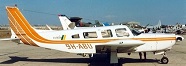
The light aircraft, Piper Lance (PA32) registration 9H-ABU, that was to bring them to Malta. made its outbound journey from Malta to Djerba, departing at approximately 17.30 (GMT) on Saturday 2nd December 1995. Before the flight Mr. Spiridione Agius, a Maltese Meteorological Officer, briefed the pilot, about the prevailing weather conditions, particularly thunderstorms in the region at the time. According to the Maltese Board of Inquiry Report into the disappearance, Captain Bartolo was given the necessary Documentation: the significant weather charts; the landing forecast for Djerba; surface charts about the current situation and developments expected thereafter.
Bartolo flew four passengers on the outbound flight from Malta amongst whom was, according to the Maltese Board of Inquiry Report, the General Manager of MAPEL, David Sills. (Cormac Boomer, the father of Desmond Boomer, however, is insistent that the correct name is Mr. David Silts whose position was MAPEL Area Manager for Libya). By all accounts it was a harrowing journey, and not just because of the prevailing weather conditions.
Three of the passengers gave evidence to the Maltese Board of Inquiry. The main thrust of their testimony is as follows:
- The aircraft headed straight into a tremendous stonn with flashes of lightening, heavy rain and hail and everything iced up. There was severe turbulence and the aircrft was thrown about;
- The portable GPS was not functioning throughout the course of the flight and on engine start-up a slight screech was heard;
- Prior to landing there was a strong smell of burning rubber and the voltmeter and amp meter had gone off. One of the passengers, Roger Woods. testified that every instrument went blank
- After landing at Djerba the passengers noted that between the propeller and the engine cowling “some sort of drive-belt” (presumed to be the alternator belt) was badly torn up and hanging out. In his evidence Roger Wood stated. "The captain just put his arm in and pulled out this belt all in bits and pieces“.
- All three witnesses confirmed that the aircraft was in no fit state to return to Malta
Supplementary evidence regarding technical assistance
During the Maltese Board of Inquiry hearings into the incident the Board called Mr. Paul Lehman, Air Safety Investigator of the Florida based Piper Aircraft Incorporation. According to Mr. Lehman, “In order to replace the alternator belt on this type of aircraft, the propeller would have to be removed, involving an in-depth repair, and is not something that can be done in a transit stop unless there is technical back-up."
Mr. Alfred Fenech, the administration manager of NCA International (an aircraft maintenance company based at Safi, Malta) informed the Board of Inquiry, in August 1997, that his company held the contract for maintenance and repair of aircraft owned by Mr. Bartolo 's companies. Mr. Fenech said that assuming all the necessary materials, specialist tools and expertise were on hand, it would require a time period of at least three hours to carry out the work of replacing the belt - a job which included removing and refitting the propeller. He also stated that before any other company undertook this work it would be required to obtain written authority from NCA to proceed Otherwise, the insurance cover held by Bartolo ’s companies would be invalid.
Furthermore, Mr. Fenech told the Inquiry that NCA did not have any agent at Djerba, but if problems arose at the outstation, his company would be contacted. Alfred Fenech moreover states that Carmelo Bartolo never requested such a service.
According to the ‘Handling Charges Receipt’ documentation collected by the Maltese Inquiry from the Tunisian Authorities, Captain Bartolo landed at Djerba at approximately 21.29 (GMT). Mr. Roger Woods confirmed to Cormac Boomer that when collecting his luggage from the forward luggage compartment, which also houses the engine, he could see that the alternator belt was “hanging in shreds." He drew the attention of the pilot to its condition. The pilot, according to Boomer, then reached up and pulled it off and carried it with him as he and the other passengers walked to the terminal building where they arrived at about 21.45 (GMT). Before parting company with pilot Bartolo in the terminal building he enquired about the fitting of a new belt and was informed that there would be plenty of time to do this as he would be waiting for the weather to improve.
According to evidence presented at the Board of Inquiry Captain Bartolo checked into the Hadji Hotel where he, allegedly, met two of his return passengers, Mr. Matthew Aquilina and Tadeusz Gorny. It appears that Boomer remained at Djerba Airport. However. since Boomer and Gorny, two MAPEL employees, had travelled together from Libya and neither knew Aquillina, why would Gomy and Boomer separate? Furthermore. we do not know the source of this information. Since pilot and passengers disappeared, how do we know that Bartolo met Aquillina and Gomy at the Hadji Hotel? If, indeed, the pilot and two of his passengers actually checked into the hotel, is there a record to show they checked out a few hours later in order to proceed with the flight to Malta?
Another passenger in the outbound flight from Malta, Mr. David Silts, Area Manager for MAPEL Services in Libya, later informed Cormac Boomer that shortly after arrival he had coffee with Desmond Boomer and Tadeusz Gorna (21.45 GMT) in the coffee lounge at Djerba Airport. Silts said he did not mention the matter of the frayed belt to them because he did not expect the plane would take-off until sometime on Sunday when repairs had been carried out and the weather had improved.
From the report of the Tunisian Bureau for the Investigation of Accidents, the flight to Malta obtained start-up clearance from Djerba Tower at 02.38 and takeoff clearance at 02.45 (GMT) Captain Bartolo’s wife, Antonia, testified that her husband called her at 21.45 (GMT) on Saturday 2nd December from Djerba, to inform her that he was going to stay overnight. If indeed, he changed his mind and decided to fly back that night, he did not make a follow-up phone call to inform his wife. Why?
However, a Mr. Lagha Ezzeddine (Tunisian Bureau for the Investigation of Accidents, and also a member of the Tunisian Commission which conducted the Inquiry into the disappearance of the aircraft) states that notwithstanding the Weather conditions, Mr. Bartolo decided to take-off and in effect the airport runway lights were switched on for the aircraft to depart. It appears that no one in authority at Djerba Airport or with links to the Tunisian Aviation Authority raised objections or voiced concerns for the safety of the flight, given the inbound mechanical difficulties the aircraft had experienced and the raging storm into which the light plane was about to fly with a compliment of international passengers. Mr. Ezzeddine also states that after landing at Djerba, Mr. Bartolo did not request any maintenance assistance. Furthermore, on the day in question, no other light aircraft took off from Djerba airport. presumably because of the adverse weather conditions. The question, however. remains, did Bartolo‘s aircraft actually take-off or not?
Search and Rescue
According to the Maltese Board of Inquiry report, “there was no contact between the aircraft and Maltese Air Traffic Control on the set frequency.” The report states that Air Traffic Control made contact with a Royal Air Maroc aircraft. It was instructed to try and establish contact with the Piper Lance, which had not reported at the FIR boundary According to the report, no reply from the Piper was received.
Edmond Mangion, Control Officer at the Air Traffic Services, told the Inquiry that the flight was treated at this stage as a communication failure. Was this normal procedure?
Mr. Mangion told the Maltese Inquiry “that when after an hour they had seen nothing on radar the ALERFA phase was started at 0518 GMT. He told the Inquiry that he telephoned. amongst others. the Senior Air Traffic Controller and the rescue coordination centre at Air Force Malta (AFM). Colonel C Vassallo. Principal Staff Officer AFM, told the Inquiry that he was responsible for search and rescue operations. He stated that a Mr. Joe Sultana, whose role is not made clear in the ofiicial report, notified him ofthe missing aircraft at 0610 GMT Colonel Yassallo instructed AFM operations centre to prepare the necessary charts for his arrival at the centre at 0640 GMT. At 0745 the rescue coordination centre informed .\Ialta Radio to start broadcasting distress messages so that ships in the area would keep a lookout for any survivors. Members of the Maltese public on CT radios picked up these messages.
Colonel Yassallo informed the Maltese Inquiry that due to a lack of suitable search aircraft at his disposal. contact was made with Excelair, Captain Bartolo’s company and a briefing was given to two Pakistani pilots to enable them to carry out search procedures using Excelair aircraft.
Vassallo informed the Inquiry that the first aircraft, operated by the Italian Military, was dispatched on search and rescue duties at 0912 GMT. (This is almost four hours after concern for the safety of the flight was first recorded!) Other local civilian aircraft operators were called on to assist in the operation.
According to the Board of Inquiry Report. shipping vessels and oilrigs in the Mediterranean were contacted and asked to participate in the search. According to Cormac Boomer, Philip Bartolo (now deceased), the son of missing pilot, Cannelo Bartolo, told him in November 1996 that private fliers in their own planes were the first people in the air in the search and that the first planes took off one-and-a-quarter hours after the mayday was broadcast. “He explained to me that the planes spread out over the course it was expected his father would fly on his return trip from Djerba. They flew at around 500/1000 feet into the storm to the general area of the reported crash and they saw and found nothing. I recall he repeated what he first said to me when we first spoke on the phone in December 95. “No one will ever convince me that that plane went down in the water and nothing floated from it.”
According to the Maltese report, the US Embassy in Malta offered assistance at 1100 GMT. At 1400 GMT, a USAF P3 Orion aircraft was dispatched from Sigonella Air Base, Sicily.
According to the report the search operation continued from 3rd-10th December 1995 and concentrated on the FIR boundaries between Malta, Libya and Tunisia. The report also states that the Tunisians and Libyans also assisted in the search operations, but no details of how are given.
According to the Maltese report, “During these operations various signals and other information were received from extraneous sources... In particular [a] distress signal monitored by satellite COSPASAR and received by the French receiving station based in Toulouse. It was ascertained that the signal could be attributed to a transmitter in Libya". According to the report, Colonel Vassalo requested the Libyan Authorities to deactivate their transmitter. As “a possibility existed that other weaker distress signals would be interfered with". This, however, does not make sense. Why would any principle staff ofiicer of one rescue mission request that a distress signal from another source be deactivated in order to facilitate his rescue mission’? Also, is it possible the distress signal was, in fact, coming from the Piper Lance aircraft in Libya”
Colonel Vassalo informed the Inquiry about a message received from the Tunisian authorities regarding a distress call from a supply ship named the “Asperay”. The Maltese Inquiry report states, “A similar distress signal is also alleged to have been received by the same authorities from the supply vessel ‘Gonfulut’”. The report states that Colonel Yassalo "personally checked on these ships with Lloyds Maritime Information Service and was informed that Lloyds had no records about such ships”. If this is true. serious questions must be raised concerning the purpose behind these actions by the Tunisian authorities. It would appear the Maltese authorities did not pursue this line of inquiry. Why? Furthermore, the report is not specific concerning how the above distress signals were received by Tunisia and relayed to Malta.
Wreckage Found
The Maltese Board of Inquiry Report states that on 11 October 1996, Mr. Anthony Mangion. then Permanent Secretary to the Ministry for Transport, Communications and Technology, brought to its attention copies of messages received from the Ministry of Foreign Affairs regarding items (reported first in the local press) to have been found by a Tunisian trawler of the Gulf of Gabes. On 14 November 1996 he produced photographs of the wreckage taken by the Maltese Charge d’Affaires in Tunis These also included photographs of a wallet and its contents allegedly reclaimed from the wreckage. No specific date is given in the report regarding the actual date the wreckage was discovered. Furthermore, the report does not give details of the circumstances surrounding the alleged discovery, by whom and precise co-ordinates. Furthermore, the photographs were first shown to the family of missing passenger, Mathew Aquilina, by the Maltese Aviation Minister (name and date?) on the eve of the Maltese General Election.
Cormac Boomer was shown the photographs during one of the Maltese Board of Inquiry hearings. He claims that one photo of the wreckage showed an oval window, the significance of which, he says, did not strike him at first. Later when recalling the photographs he realised that this Piper Lance model did not have any oval windows. He raised this issue with the Inquiry and asked to be shown the photographs again. He says his request was denied.
The report states that “following the recovery of the Wreck, a search was carried out in November 1996 in the indicated area, wherein patrol boats, maritime patrol aircraft, MV Princess Duda a locally registered diving vessel chartered by the Malta Maritime Authority, as well as AFM and civilian divers participated." The report states, “This search proved unfruitful
Examination of Wreckage
Cormac Boomer. an engineer by profession, states:
"In the course of the many public sittings of this Inquiry held in Valletta I found it necessary to publicly question much of the evidence presented, in particular that relating to the small quantity of wreckage which included the pilots wallet cash and keys that mysteriously surfaced in the nets of a Tunisian trawler ten months aiter the report of the incident. To date no member of the crew have been named, or indeed, has the vessel been identified. The co-ordinates at which the find was supposedly made have not been made public and it was a further six months before these items of debris were returned to the Malta Government.”
"On 16 May 1997 I examined and photographed these items and it is obvious their condition was not compatible with their having spent ten months in the salt brine of the Mediterranean Sea. There was no indication of salt pigment or the corrosion one would expect to find in such circumstances. It is claimed the aircraft fell from a height of 9000 feet into the sea in a severe storm. It is strange. therefore, that the cable looms running through the trusses attached to the debris/components do not show any indication of the stretch, arc or rupture one would expect to find arising from the impact and ripping apart which would occur in an aircraft descending in a headlong plunge from 9000 feet. From my visual inspection and the photograph evidence it is obvious the ends of these cables have been severed with a cutting tool.”
According to the Board of Inquiry Report, Piper Investigator, Mr. Paul Lehman, “made reference to the missing alternator belt and the depletion of the aircraft battery. He affirmed that a fully charged battery would render 30 minutes of energy. (This also begs the question - who charged the battery before take-off?) However, if indeed the battery was fully charged, considering the energy required to start the aircraft engine, the remaining battery life would, says Mr. Lehman, not be more than 10-15 minutes. Moreover he asserted that in flight, once the battery went flat, the pilot would have lost all communications, Distance Measuring Equipment, Auto Direction Finding, ATC transponder, stall warning hom, autopilot, normal landing gear extension, pilot tube heat, turn and bank indicator, instrument, cockpit, navigation and landing lights.” However, according to the same report “communication between the aircraft and Djerba Air Traffic Control continued until 04.10 when the controller requested the pilot to change the frequency with Malta. This is substantiated by the tape recording and the transcripts of the tape of the communications between aircraft and Djerba Control Tower. However, the families of the bereaved, in particular, the widow of Captain Battolo, dispute the authenticity of this tape.
The report informs us, however, that the aircraft was given take-off clearance by the Djerba Control Tower at 02.45 GMT. If as Mr. Lehman states, the aircraft had a depleted battery, after take-off the aircraft communication system would have worked for just 10-15 minutes. This means that by 03.00 GMT all communications between the missing aircraft and Djerba Air Traffic Control would have ceased. If, however, communications did continue until 04.10 GMT, this would suggest that the aircraft had a fully functioning alternator belt and further raises the issue of Captain Bartolo having received major mechanical support at Djerba Airport prior to departure. There is nothing to substantiate that this in fact was the case.
Mr. Lehman told the Maltese Board of Inquiry that following his examination ofthe recovered wreckage he was satisfied it belonged to Piper Lance 9H—ABU and that it was his expert opinion that the aircraft had crashed into the sea.
On Thursday 14 June 2001 we telephoned Mr. Lehman at The New Piper Aircraft Incorporation, Vero Beach, Florida, concerning his examination. A number of telephone calls were made. during which we left one voice message explaining the nature of our call and asking him to call us back. We also left similar details with a secretary on a subsequent call. Four hours after our first call, at approximately 20:00 GMT called again and were put through to an extension answered by a female who identified herself as a legal adviser in the presence of Mr. Lehman. Mr. Lehman and the caller conducted their telephone conversation with us by conference. From this end the conversation was conducted by Don Mullan, who identified himself as an investigative journalist form Ireland. researching the circumstances around the disappearance of the Piper aircraft for a possible television documentary. Mr. Lehman was asked if he would be willing to give an interview for a television documentary. His lawyer, however, stated that questions would need to be forwarded in advance before a decision could be taken. Mr. Lehman was asked if he was satisfied the aircraft had crashed into the sea. He was heard saying to the female lawyer, "I have no difficulty in answering that” to which the lawyer replied, “Okay.” He said. "Yes Sir. I believe that to be the case.” Mr. Mullan then asked Mr. Lehman if he could be certain that the aircraft crashed on the night in question. He replied, “No Sir. I can't say that for sure.”
Mr. Lehman provided us with his email address for the purpose of forwarding questions. That evening an email was sent to him requesting a copy of the summary and detailed reports submitted by him to the Maltese Inquiry, to facilitate the formulation of relevant questions by us. The reports are awaited.
In a letter to the Chairman of the Inquiry, sent by Dr. Christian Farrugia of Farrugia and Associates Law Firm, Valletta, Malta, (the legal representative of Desmond Boomer’s widow, Mandy, and the Aquilina family) he stated:
The wreckage of the aircraft (and personal identification documents of the pilot allegedly found by fishermen in Tunisian waters months after the incident occurred, evidenced the destruction of the plane. While the Board could deduce from this fact alone that the aircraft fell in sea water, it would certainly have been more profitable if the wreckage had been forensically tested by an independent agency to determine with some precision (i) the precise mechanics of the disaster, (ii) how long the plane lay on the seabed before its discovery (m) whether any traces of human tissue could be found in the plane or any part thereof and (iv) whether there was an indication of explosion or fire. The latter question may be said to have been prima ??? resolved by the absence of any clear signs of burning or fire on the wreckage but should have been further investigated after members of the Bartolo family mentioned a couple of incidents raising the possibility of foul play aimed at the pilot in the days leading to his departure on the outbound flight from Malta to Djerba
The fishermen who found the wreckage were never properly questioned by the ??? or made available to counsel representing the various interested parties in the ????? further questioning. It seems that no effort in this direction was ever made even though it is clear that their testimony on the subject was of vital importance. These fishermen could have answered some of the lingering questions which still abound regarding the discovery of the wreckage viz (i) where precisely was the plane found, (ii) how many fishermen were present at the time (iii) who exactly found the pilot’s wallet/documents/cash and where (iv) were any other smaller parts found in the nets and discarded, (v) who informed the Tunisian authorities about the find, (vi) where was the wreckage first placed on land before delivery to the authorities (vii) were all pieces of the wreckage found delivered to the authorities. While it is appreciated that tracing and bringing the fishermen over the Malta would have been no mean task, more effort could have been put into the matter, particularly considering the extensive protraction of the inquiry caused by the non-arrival of the tapes.
Political Background to Disappearance
On 26 October 1995, the leader of the Islamic Jihad, Fathi Shqaqi, was on a secret visit to Malta. To avoid detection by the Maltese authorities Shqaqi entered the island on a false passport. However, unknown to the Jihad leader, he was shadowed by members of the Israeli secret service, Mossad. A decision had been taken by the Israeli authorities to assassinate Shqaqi, codenamed Operation Caesarea. According to Mossad files, ‘Commission X’ which met in an office on the 2nd Floor of the Israeli Ministry of Defence in Tel Aviv on 26th January 1995 took the decision. A few days prior to this decision Fathi Shqaqi had claimed responsibility for terrorist attacks in Israel in an interview for an Arabic newspaper in London.
Operation Caesarea was planned and put into action. At least 40 Mossad agents, shooters, security specialists, managers and communications technicians were deployed to Malta, Sicily and Libya. By September 1995, a C3 centre (command, control, communications) had been set up in a house in Valletta. Agents, posing as “rich tourists together with their wives”, brought in equipment. Mossad was alerted that Shqaqi would soon be passing through Malta on his way to Libya for a meeting with Libyan Leader Muammar Ghaddafi. It was decided that they would take him out on his way back.
When the Mossad base in Malta was notified that Shqaqi had taken the ferry “Garnata" from Libya to Malta, a speedboat carried the operation’s commander and the hit man to Malta from Sicily. They landed on the shore under the Fortina Hotel in Tigne and were taken by two cars to the safe house in Valletta. Mossad agents posing as tourists, businessmen, oil experts and a retired naval officer were already in place and had hired several cars from a local garage.
By now, Shqaqi had arrived in Malta and was under constant observation by the Mossad operatives. After a shopping spree in Sliema, Shqaqi was on his way back to his hotel when two Mossad agents on a motorcycle approached. The hit man walked up to Shqaqi, drew his attention, and fired three shots to the head. As the Jihad leader lay dying. another three shots were fired. The hit man was driven away on the motorcycle amid the screams of passers-by who had witnessed the shooting.
According to details of this operation published in Soldier of Fortune magazine the hit man and his driver were taken to Tigne where they boarded a speedboat and in 30 minutes were back in Sicily together with their commander where they boarded a private jet which took them back to Tel Aviv. This may, or may not, be true.
However, on 5 November 1995, precisely one month before the mysterious disappearance of Desmond Boomer and his travelling companions, a local Maltese newspaper KullHadd. wittingly or not, implicated Carmel Battolo, a Maltese pilot and owner of two small private airline companies, Excelair and Sun Aviation, as an accomplice in the assassination of Shqaqi. The newspaper carried a front-page report that the Shqaqi assassins may have left Malta on a Maltese registered and piloted private plane. Alarmingly, the paper printed alongside this story a photograph of an Excelair aircraft. The company owned by Bartolo. The significance to this story is that Bartolo was the pilot responsible for flying Desmond Boomer and his fellow passengers to Malta on the night of their disappearance.
In addition. on the 9 November 1995, The T imes of Malta lead with the heading, “Shqaqi s assassins may have left Malta on private plane". The article stated that the Maltese police had received information from Interpol detailing how the assassins left the island For security reasons no further details were given but The Times article continued: “ ..other sources said the police were working on the theory that the men left the island on board a private plane hired from a local company and flown by a Maltese pilot."
Cormac Boomer’s Search for his missing son
Cormac Boomer was officially informed that his son was missing in a presumed air crash in the Mediterranean. He says that in the days that followed he endeavoured to come to terms with what he could only perceive as a tragic accident. However, two weeks after the incident, he received a phone call from Geoff Williams, the brother of Michael Williams, the British passenger also missing from the flight, which was to radically change his view of the incident. “It set me off on the long search for my son,“ says Boomer. “If I could not find him, I at least wanted to find the truth surrounding his disappearance".
In a sworn affidavit, presented to a Maltese Inquiry into the incident, Boomer states that Williams informed him that on the 12 December 1995, his nephew Andrew, the son of Michael Williams, was in a government building in Malta where he was investigating the circumstances of his father’s disappearance. While there, he told his uncle, he met a Maltese public figure. Andrew Williams told his uncle that this person took him into his office, instructed his staff to leave and shut the door. The public figure is reported to have stated, “We feel you have a right to know your father’s plane did not come down in water. It is on land and we know where it is.” Andrew Williams, the affidavit states, asked him how he knew that. The person replied, “Our surveillance system monitored its distress beacon for seven hours after it’s reported disappearance.” According to the affidavit, William’s then asked the person if the plane was not in the sea was it on land and, if so, was it Tunisia. He replied ‘No’ Williams then asked. “Is it in Libya?” The public figure is said to have responded. "Its on the ground in Tripoli‘. According to Boomer, he then said to Andrew Williams. "If you repeat this conversation to anyone outside this room I will deny that I ever made such a statement." After hearing this story from Geoff Williams. Boomer asked him, “Did Andrew give you a name?” Williams replied, "Philip Sciberras" It was the first time Boomer had ever heard the name and he recorded it immediately. Geoff Williams presented a sworn affidavit to the Maltese Board oflnquiry in support of Boomer’s.
In January 1996, a Dr. Philip Sciberras was appointed Chairman of a Maltese Board of Inquiry into the disappearance. He has publicly refuted the details of Boomer’s affidavit and threatened legal action. He has failed to follow through with his threat and both Boomer and Williams have refused to Withdraw the serious allegation contained within both affidavits.
Maltese Board of Inquiry
In pursuit of the truth surrounding his son’s disappearance, Boomer attended, at his own expense, ten sittings of the Board of Inquiry in Valletta, chaired by Dr. Sciberras. Boomer says that in the course of the Inquiry, “I have found it necessary to question much ofthe evidence presented.” He sites the example of wreckage allegedly discovered by unidentified Tunisian fishermen on the 20 September 1996, at a location where coordinates where never given to facilitate further investigation.
“The wreckage mysteriously surfaced in the nets of a Tunisian trawler," Boomer, an engineer by profession, states. “It included the wallet and keys of the pilot. I have examined and photographed these items and it is obvious they do not show any sign of the deterioration and corrosion one would expect to find on components submerged in salt Water for ten months. It is also claimed the plane crashed into the sea from a height of 9000-feet. Strange, therefore, that the cables and looms attached to these components do not show the signs of stress one would expect from an impact of such force. The Maltese authorities, moreover, have failed to send the debris for expert forensic analysis to a specialised laboratory. I am curious as to why not?”
Board of Inquiry Conclusion
The Maltese Board of Inquiry into the disappearance was to place ultimate blame with pilot Carmel Bartolo. The Board concluded that the light single-engine Piper Lance aircraft had been recklessly flown by Bartolo, from Djerba Airport, Tunisia, right into a menacing Mediterranean storm, despite mechanical difficulties on a harrowing outbound flight. The aircraft, in this scenario, is presumed to have crashed, resulting in the death of the pilot and all five passengers. According to Cormac Boomer the Board gave this view while ignoring crucial evidence that he believes clearly undermines such a conclusion. “They chose the soft option," he states, “and drew conclusions which defies logic and commonsense,”
According to Boomer, the Maltese authorities would prefer this to be the conclusion, since it avoids consequent diplomatic tensions between its three powerful neighbours: Israel, the Arab World and the European Union, the latter block which Malta is actively aspiring to become a member of.
Despite the largest air and sea search since the Second World War, conducted in the immediate aftermath of the disappearance, nothing was found and no bodies were ever recovered, The search involved sea and aircraft from five countries: Malta, Italy, Tunisia, France and the United States. The latter used specialised underwater search equipment, concentrating on an area in the Gulf of Gebas where, in this scenario, the plane was suspected of crashing Absolutely nothing was found.
Boomer claims that in 1997 during an encounter with a member of the Maltese Armed Forces involved in the initial ‘May Day’ alert, he was told, “My government knows the plane did not go down in the water."
On the 5th anniversary of his son’s disappearance, Cormac Boomer wrote to the Irish Government, requesting it to press the Maltese authorities, through the European Parliament, to establish an independent international inquiry. He requested that as part of the EU's favourable review of Malta’s application for membership, the Government of Malta should be called to account for its handling of the investigation into Desmonds disappearance and his travelling companions. “My experience has lead me to the conclusion," he says, “that the Maltese authorities will continue to ignore the lonely voices of the bereaved until such times as my own Government, the British Government and the European Parliament, support our demand for truth and accountability based on international standards,”
Questions
Why would Bartolo book into a hotel if he had even the slightest thought of flying back that night?
Why would some of Bartolo’s passengers book into a hotel also, unless the pilot confirmed they would not be flying that night?
If Bartolo and others checked into a hotel and then decided to leave, is there a record of them having checked out a few hours later?
Is there any record of the disappeared having paid by either cash, cheque or credit card for their hotel accommodation?
If maintenance was carried out on the aircraft, who did it and when? Was the spare part(s) available in Djerba? If so, how do we know this?
Was a certificate of airworthiness issued following the maintenance, if carried out?
Is there any documentation available to confirm that Bartolo sought maintenance support along with a report of the work done to ensure payment by his insurance company?
If maintenance was carried out, was Bartolo’s insurance company ever issued with a bill for payment? Was a cheque ever drawn from any of Bartolo’s accounts to cover such maintenance or, perhaps. a corresponding monetary withdrawal from an ATM to cover such maintenance’?
What are the names of any maintenance companies working at Djerba Airport who could carry out such repairs to the type of aircraft flown by Captain Bartolo?
Between 19:29 when the plane landed and 19:45 when Bartolo called his wife, he had 16 minutes in which to inspect the plane, consult on possible technical back-up for repairs and decide he was not flying that evening. Why did Bartolo not call Fenech in Malta to inform him of his mechanical difficulties and to arrange technical back-up from either Malta or from within Tunisia’?
Why did the report choose to use tvro different time zones when recounting the movements of the aircraft leading up to its disappearance?
Page 13 of report refers to Mrs. David Sills General Manager, MAPEL, while page 33 refers to David Sills. Managing Director. MAPEL Why?
At what time was the briefing given to the two Pakistani pilots and by whom?
What time were they airborne and for how long?
What was the nature of the briefing?
What course was it suggested they should search?
Where are the ‘official’ photographs of the wreckage? More importantly, can a complete set of uncut negatives be produced to prove or disprove Cormac Boomer’s allegation that one photograph shows an oval window?